

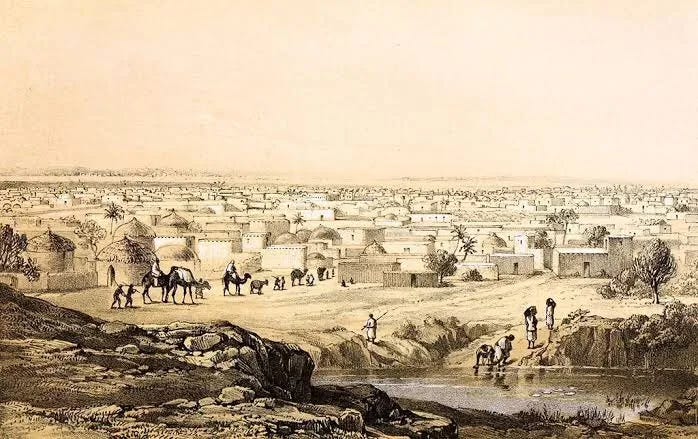
Known by many historians as the Sokoto Caliphate, even though opinions differ on its status as a fully comprehensive caliphate. It stands as one of the most remarkable examples of Islamic revival and governance in African history, a civilisation that strove to establish Islamic reform, education, and just leadership and endured for nearly a century.
Established in the early 19th century by Uthmān dan Fodio, the Sokoto state emerged as one of the largest Muslim states in West Africa and a powerful model of what becomes possible when knowledge is coupled with action.
It was a society shaped by Islamic learning, social justice, and sustained intellectual productivity, driven by scholars, soldiers, educators, and reformers rather than elites alone.
In the late 18th century, Uthmān dan Fodio began calling his society back to the core teachings of Islām. With courage and clarity, he challenged rulers who had abandoned Sharīʿah, allowing corruption, un-Islamic practices, and moral decay to take root.
His Daʿwah was not reactionary; it was principled, scholarly, and rooted in concern for the spiritual and social wellbeing of the Ummah. Uthmān dan Fodio emphasised that true Islamic governance requires adherence to Sharīʿah, moral integrity, and justice, and that reform must begin with both knowledge and action.
As has so often been the case throughout Islamic history, when sincere reform movements confront unjust power and seek to establish Sharīʿah as a lived reality, resistance intensified. Attempts were made to silence, restrict, and persecute the movement. Yet repression did not extinguish the call, it refined it.
Facing oppression and injustice, he and his followers embarked on migration and engaged in Jihād (physical fighting), a method long practiced throughout Islamic history to restore justice.
Their struggle gave rise to the Sokoto Islamic State in 1804, with Uthmān dan Fodio as Commander of the Faithful, a living example of knowledge, courage, and action in service of the Ummah.
The Sokoto state remains a living reminder to Muslim reformers today: knowledge must lead to transformation, faith must confront injustice, and sincere leadership, anchored in Taqwā and scholarship, can reshape societies.
Governance and Structure
The Sokoto state was not a static kingdom but a federation of emirates united by Sharī’ah. Local leaders administered the provinces while remaining answerable to the ruler in Sokoto, establishing a framework of accountability that safeguarded governance. This arrangement enabled the uniform application of Islamic justice and ensured its reach across the provinces.
Islamic principles were central to governance:
Sharī’ah courts resolved legal disputes according to the Maliki jurisprudence.
Bayt al-Māl (public treasury) distributed wealth for public welfare, including students, teachers, the poor, orphans, and travellers.
Officials were appointed on the basis of piety, knowledge, and demonstrated competence, rather than lineage, social status, or wealth.
This foundation helped the state maintain internal cohesion and legitimacy, making Islām a lived social order.
Education as the Heart of Reform
In the Sokoto state, Islamic education was central. Knowledge was a tool for moral guidance, social transformation, and Islamic revival. Scholars across the state wrote extensively in Arabic, Fulfulde, and Hausa on law, theology, governance, and ethics.
Uthmān dan Fodio, his son Muḥammad Bello, and brother ʿAbdullāh dan Fodio produced works that shaped Islamic thought across West Africa, showing that learning must always lead to action.
While some Muslim scholars may critique some extreme Sufi practices present in the Sokoto state, it is important to recognise that certain practices of the time, though not always fully supported by evidences were common cultural practices that take time to correct. We should not rush to judge, but rather learn from the state’s enduring commitment to establishing the Sharīʿah and moral reform.
The Sokoto model remains a source of inspiration for Islamic revival today.
Women at the Heart of The Revival
The intellectual revival of Sokoto was inclusive. Nana Asma’u, daughter of Uthmān dan Fodio, pioneered the Yan Taru movement, training female educators called jajis to teach women Islām, literacy, and moral conduct across communities.
Using poems and study circles, they made knowledge accessible to all, demonstrating that societal reform requires the active participation of women.
Justice and Moral Governance
Under the Islamic state, the justice of Sharīʿah was upheld, and oppression was removed. Markets were regulated for fairness, welfare and education were publicly supported, and literacy in Islamic sciences flourished.
The Sokoto state illustrates that faith, knowledge, and justice are inseparable in building a thriving community.
Only under the shade of Sharīʿah can humanity find true justice.
The Downfall by Colonial Powers
Oppressive colonial powers, driven by conquest and exploitation, dismantled the Sokoto state’s political authority in the early 20th century. They imposed foreign rule, disregarding the Islamic systems of justice, education, and governance, and sought to weaken the moral and intellectual foundations that had sustained centuries of Islamic revival.
Though political control was taken, the scholarly, educational, and ethical traditions of Sokoto endured, continuing to guide and inspire Muslims to connect knowledge, action, and social responsibility.
For reformers and activists today, the Sokoto state example teaches that when faith, learning, and moral courage unite, societies can be truly transformed and defended, and that oppressive powers may delay, but cannot erase the work of reformers committed to justice.
Lessons and Benefits for Muslims Today
The legacy of the Sokoto state is not merely historical; it is instructional. For Muslims committed to reform, revival, and justice today, it offers enduring lessons:
Knowledge Must Lead to Action
Uthmān dan Fodio demonstrated that true education is incomplete without action. Scholarship that does not challenge injustice or uplift society remains limited. The Sokoto model reminds us that learning is meant to transform communities, not simply inform individuals.
Reform Begins with Moral Courage
Calling society back to the principles of Islām requires clarity, patience, and bravery. Dan Fodio’s Daʿwah shows that principled critique, rooted in sincerity and knowledge, is a necessary component of meaningful reform.Resistance Is a Sign of Impact, Not Failure
Opposition often arises when sincere reform challenges entrenched and unjust power. The Sokoto experience teaches Muslims that resistance is not a setback but a sign of meaningful impact.True revival demands sacrifice, of comfort and security, for the sake of justice. Reformers are called to embrace these trials as part of the path of Islāh (Reform), knowing that enduring resistance is a recurring reality for those committed to transforming society.
Sharīʿah-Based Leadership for Just Governance
Authority in Islām is not inherited or purchased; it is earned through Taqwā, knowledge, and service. Sustainable reform requires leaders who govern according to Sharīʿah, embodying the principles of justice, accountability, and moral integrity in every decision.True leadership is measured not by power or wealth, but by adherence to Islamic values and the welfare of the people.
Education Is the Backbone of Revival
The intellectual productivity of the Sokoto state shows that lasting change is built through teaching, writing, mentoring, and cultivating future generations. Reform that neglects education will not endure.Change Begins Beyond the Classroom
Uthmān dan Fodio’s legacy shows that true knowledge comes alive in action. Muslims must learn and act with courage, bringing faith, knowledge, and justice into family, community, and leadership.
Ultimately, the Sokoto state stands as a reminder that when faith is sincere, knowledge is lived, and action is principled, Muslim societies can rise, even in the face of overwhelming odds.
Ibrāhīm Hussain
Al-Harakah Research Team
References:
The African Caliphate (Book 1 & 2) by Malam Ibrāhīm Sulaimān
Journal research on ethical foundations and educational influence - Al-Hikmah University